 MYCRMS
 Virtual Tour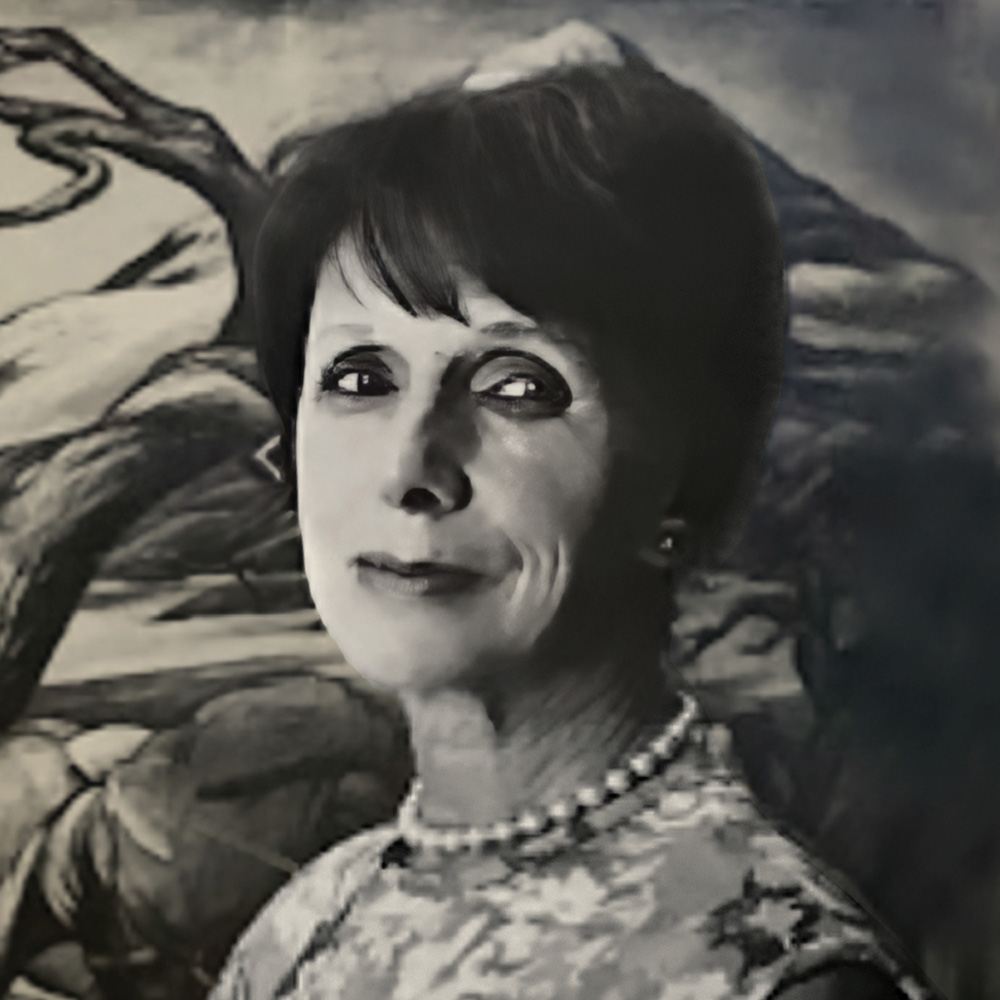
The Holdens met Paula Mechau and her family at a neighbors’ house one summer evening in 1953. According to John, Paula and her four children sang “pure folk songs, in the purest possible way–clean, clear and absolutely unadorned.” A few days later, Paula and her youngest son, Mike, stopped by the Log House. She’d been teaching in Grand Junction but wanted to remain in the valley for the winter so Mike could attend the school. The Holdens hired Paula as school secretary and folk song teacher to start September 1st in the school’s inaugural year.
Paula Mechau
by Claudia Bach
From The First Twenty-Five Years (1979)
Over coffee in her Redstone kitchen, with the wood burning stove dispersing the morning chill, Paula tells me how she first heard about CRMS. I settled back to listen, feeling wonderfully comfortable in that peaceful, gracious house with Frank’s paintings, Vanni’s miniatures, the Bruegal print with the three-legged man, the pressed flowers on mounted cards, the dried aspen leaves in the ceramic vases, and Paula herself with her silver cigarette holder.
Dorik, her oldest child, then at St. John’s in Annapolis had read the 1953 Time Magazine article on the Holdens and wrote Paula about it. She was in Grand Junction teaching folk music at the public schools. Since Frank’s death, seven years earlier, Paula and the children had spent winters away from Redstone. Paula laughed, “A private school in Carbondale, can you imagine? I couldn’t believe it.”
The years from 1946 to 1953 must have been difficult for the family, although Paula never says so. They first had moved to Woodland Park, then to Colorado Springs, to Carbondale, and finally to Grand Junction. Paula had worked in a Bookshop, operated a preschool, and taught music. She does not talk about the hard times, but rather that she and the children were able to sing at places like the Colorado Fine Arts Museum, the Aspen Opera House, and the Redstone Inn. During those years Jose white taught Vinny two songs on the guitar, and Collier’s magazine wrote an article about the Mechau’s entitled, “The Singingest family in America.” Curiously, from 1949 to 1951 the family lived in what is now the headmaster’s house.
In 1953 when Paula came to work at CRMS, she and Mike, who was then a junior at the school, commuted daily from Redstone. When the enrollment jumped from 18 to 34 students the following year, half of the boys had to sleep in tents, while the other half moved out to a ranch several miles away (now the Ranch at Roaring Fork). Mike and Paula were among the students and faculty to move out to the ranch. They stayed there until the Sheep Barn at the school had been converted into the boys dorm. Later that year she moved into a motel in town and continued working as John secretary. During that year her daughter, Vanni, whose husband was in the Service stayed with Paula and taught a fly tying evening activity.
Soon Paula’s duties increased. She worked with John on admissions, correspondence, fundraising, and the Alumni Bulletin, which at first was run off of the mimeograph machine. She offered evening activities in folk music and after Rachel Brown taught her, in leaving. She served as counselor to the girls for many years.
By the third year she had moved into the log house which served then as a little bit of everything: assembly room, Library, office space, science lab, and dormitory. Paula recalls that the living room was divided into two sections, a large one with the fireplace, and a smaller area in the back for the
office she and John shared. Later Paula moved into the OGD. Later still, she moved into the main house into an apartment where the infirmary is located today.
During Joe Frank’s years at CRMS Paula offered a reading/discussion activity in which you read aloud works of writers not included in the regular curriculum. For Paula the activity was simply an extension of a family tradition, one that goes on to this day at Redstone.
When Ed Rubovits became headmaster in 1969 Paula took over the library, dropping most of her secretarial duties, except for the publication of the Alumni Bulletin. Back in the 1930s Paula had worked in the public library in Colorado Springs where she had introduced the notion of lending mounted reproductions of Fine Art. The mounted reproductions that still adorned the CRMS library are those placed there throughout the years she served as librarian.
In 1976 Paula resigned. She is quick to say that she did not retire. She resigned. At the same time she became a member of the Board of Trustees, a position she continues to hold, and that serves as clear evidence that Paula is still very much a part of CRMS.
Does this sum up Paula’s life at CRMS? No, not really. Paula has held down many jobs at the school, but these tasks speak of only a part of her contribution. As all of us know, what Paula is as a person, the values for which she stands, her High principles, her love of knowledge, and her demand for quality and excellence — these are her finest gifts to CRMS.
People should not scroll on the library floor (books are to be respected), people should not use vulgar language (our language is varied and marvelous), people should not abuse others (man is a noble creature), and people should not indulge in inferior art (good art can redeem and enlighten us). Paula’s standards are high, and while with her we are reminded through her example of how much we have fallen short of our potential and her expectations of us, and yet, at the same time, we know we are closer to perfection from having known her.