 MYCRMS
 Virtual Tour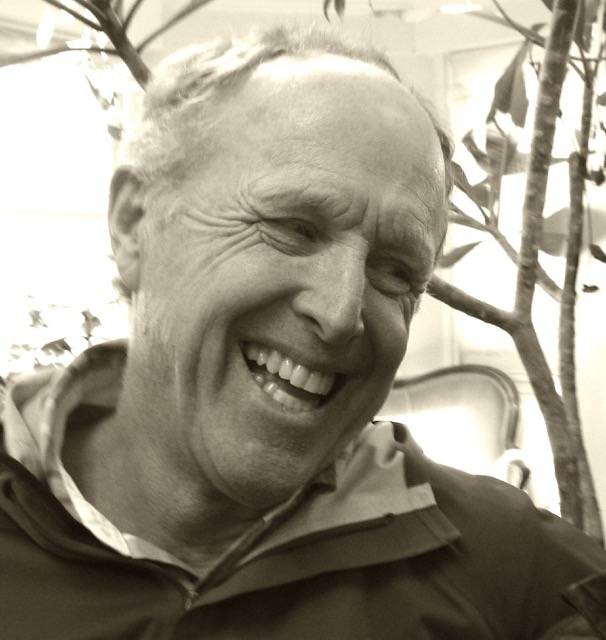
A.O. Forbes was supposed to go to Phillips Exeter Academy. His mother had long promised that come ninth grade, he’d be shipped “back east” to be, as she put it, “polished.” Instead, he toured CRMS with John Holden, watched Holden take a quick shot at a pack rat with a .22 rifle in the tack shed, then spent the afternoon clipping brush up Pizzatti Peak with a school work crew. Wells Kerr, the octogenarian Shakespeare teacher who’d once dismissed Holden from Exeter as a student, had a simple message for A.O.’s mother: “Don’t send him East, just send him here.”
A.O. grew up in Aspen back when, as he tells it, the town was small enough that “it takes a village” wasn’t a cliché but daily life. His father, a decorated WWII B-24 pilot turned author, eventually opened the House of Lum Chinese restaurant downtown; his mother taught school. Asked in third grade to name his hero, A.O. worked his way through Hector and Achilles before settling on Odysseus, “because he’s nuanced and human and fallible, and he has the spectrum of all that we are.” He entered CRMS’s 10th grade in 1966 and graduated in 1969, just as the draft lottery landed on his number: four. “I had a draft number that was either go to college and get a student deferment, or do something heroic like go to jail,” he says. “I went to school; it was easier.”
He earned a geography degree at CU Boulder and spent the next twelve years teaching at Fairview High School and Casey Middle School, quietly trying to turn public school into CRMS — “exhausting,” he admits, but “viscerally wonderful.” The turning point came over a plate of grits. Sitting at Two Rivers Café in Basalt with his wife, Janice, fresh off a hut trip in the Frying Pan Wilderness, the two realized they wanted more wilderness in their lives, not less — and then-Head of School Chris Babbs had already been writing to urge him back. In 1986, A.O. returned to CRMS to teach ninth-grade geography and geology, later adding a twelfth-grade Geopolitical Studies class he still teaches part-time at Roaring Fork High School today.
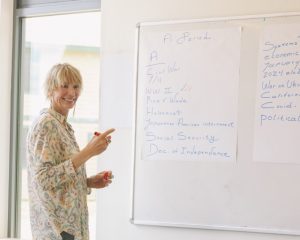
For 36 years, geography in A.O.’s classroom was never about memorizing capitals — it was, he says, “a springboard to explore the relationships between humans, resources, values, and actions.” Kayo Ogilby, sitting in on one of his classes, remembers watching him get students “wrestling with the existential angst that comes with the search for congruence between our values and our actions,” and added, “I knew I was watching a master at work. I was humbled, awed, floored, and frankly quite intimidated.” A.O. puts his own goal more simply: “The purpose of education is to figure out what you hold dear, what you value, and then find the courage to live within that.” All three of his children — Jesse, Kate, and Nick — came through CRMS with their dad as their soccer coach; Nick now coaches the boys’ team at Roaring Fork High School, keeping the relay going.
By A.O. Forbes ‘69 – April 2022
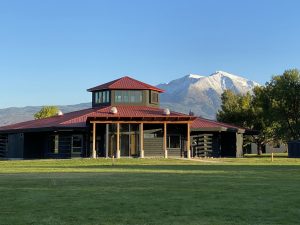
I came to CRMS in 1986 after trying to make a large public school into CRMS. After 12 years and 175 kids each day, I called and accepted an invitation from Chris Babbs, and 36 years later I leave with the most profound love and appreciation for this school. As a geographer, I believe in the magic of place, and know the Barn, blessed by James Peshlaki, to be a sacred call that ignites all things soulful, standing like a shiny beacon…
I taught a class this morning, and at the heart of the discussion were three phrases… The mystic chords of memory will swell when again touched, as surely they will be, by the better angels of our nature.” The second, rumble with vulnerability, and the third…” dare greatly”… Never thought I’d quote two republican presidents in my last missive to CRMS, but these quotes are at the heart of CRMS. Relationships are the heartbeat of the school… Relationships are given life… in class, rivers, playing music, soccer fields, trips to Juarez, Baja…endless places, where we offer a part of who are, and, ultimately, relationships give back more… they bind us to each other and to ourselves… small pieces and parts grow exponentially and when forged together become the conscience, the pulse the community that moves our school. The sheer physics of these “mystic chords of memory” call us teachers and students to relentlessly put our best selves into the arena, and arena where serious rumbles of vulnerability take place and where we all learn to lean into the notion of…”to dare greatly.” When we rumble with vulnerability, we dare to think, to speak, run rivers, climb rock faces…and expose our humanity… we live authentically.
And to be a part of this process with students, colleagues, and my children can only be described as wonder. We live in liminal moments, floating between the physical world and our mental and spiritual constructs—somewhere between the “real” and our dreams. When we pay attention, we can understand who we are by what we dream for; we can live our lives to make that dream a reality, to live in ways that honor our world’s need to dream, and remind the world to serve a common dream, that of dignity. This is the process of transformation; the acquired agility and desire to move between mind, body and spirit is the simple magic of CRMS.
On the eve of COVID, Mark and I were yucking it up around the new hand sterilizing station at the entrance to the Bar fork… lots of volume to ensure that Dr. Gaw could hear us…. musing that we were supposed to teach Camus and the plague but certainly not to live it… Yet, we both know that when times are difficult, CRMS shines bright, and like all things sacred, even more so as the years pass. But last spring a strand in the profound CRMS dialogue gripped me took my heart by storm: a school that so generously cared for, my brain, my heart my soul, a school that speaks to mind, body, spirit, is as always, a timeless formula for transformation, where community is still a sacred constant and as Kurt Hahn says, compassion is the master of our soul.
Nikos Kazantzakis is an author associated with existential notions similar to what a novelist who in the beginning a book, thought of himself as a soldier reporting to his commanding officer on a mortal mission—his life. my life. … I so love this notion that we all have a mortal mission to learn, and love the mystery of who we are on this planet… it speaks of the world, of our life in the world. And we were in caring hands at CRMS.; our mortal mission at CMRS was fleshed out in Wells’ Shakespeare class, where the full spectrum of humanity was put on vivid display, We learned to be undying optimists from Joe Frank, reading Don Quixote as we merged the spirit of a ranch with the experiential notions of John Dewey, learning from our relationship to the land and to each other only, Cervantes quixotic myths melded into the Holden’s notion that the only thing that is inevitable is that anything is possible.
Wendell Berry’s sister Mary remembers that growing up, she was told by her parents “to look and see”: look and see what is beautiful and right, and what is ugly and needs fixing, and fix it. The Holdens were just that brilliantly simple. They knew that hearts filled with beauty could not only fix anything but could create that which is beautiful and right. CRMS, the barn… is still that shiny beacon sending brave beings into our world. I will so miss being a humble part of the school.…
Read more about A.O.’s impact on Colorado Rock and Mountain School: https://www.crms.org/magazine/#crms-magazine-summer-2022/4/